Vol. I · Est. 2026

Money, technology, and the systems shaping everyday life.

Subscribe


Your HSA in 2026: Rates, Limits, and the Rising Cost of Care


Bank Impact Notes

Interest rates and medical bills both move with the economy. Your HSA sits right where they meet.
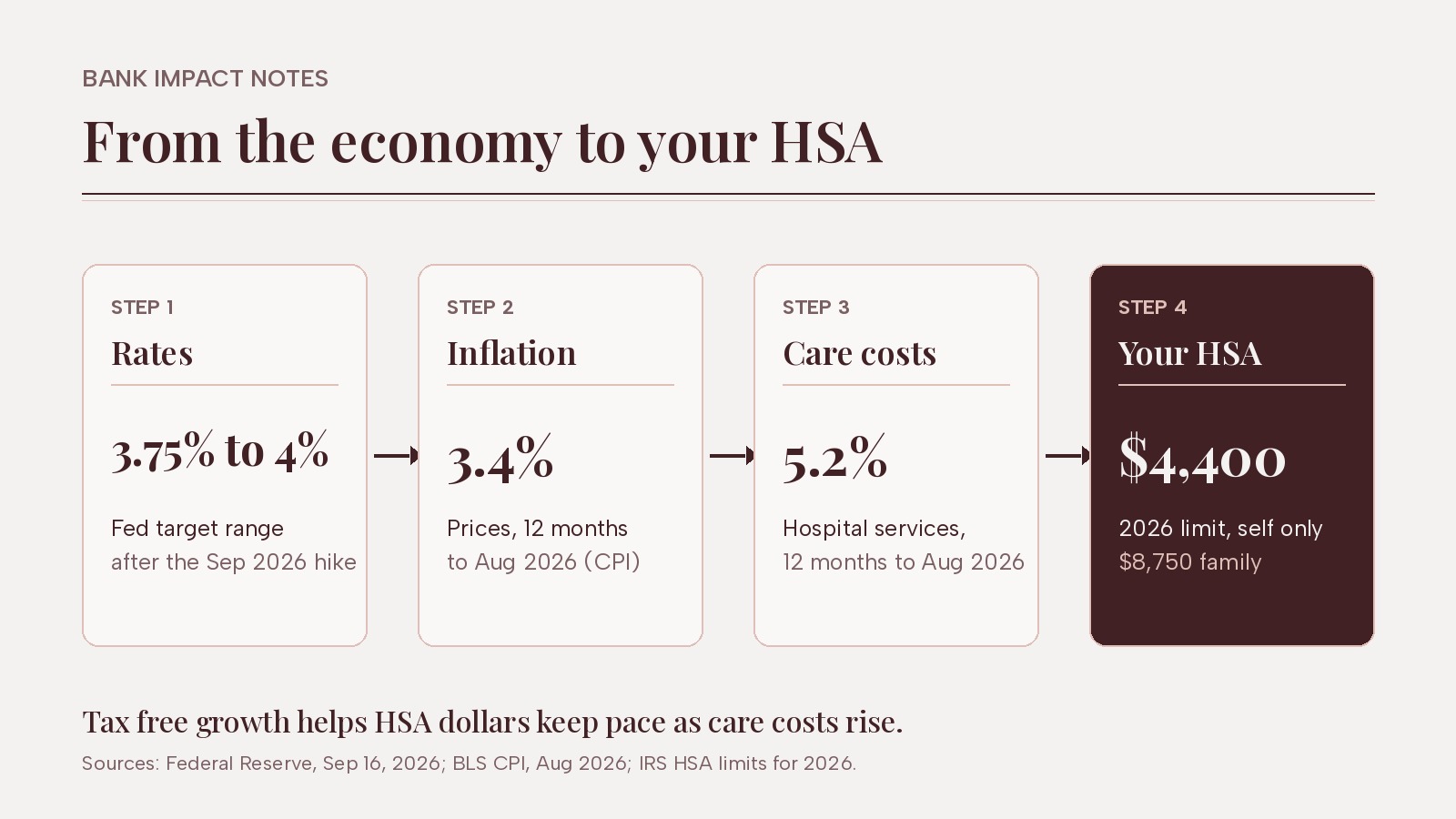
Path diagram: Fed target range 3.75% to 4%, CPI inflation 3.4% over 12 months to August 2026, hospital services up 5.2%, leading to the 2026 HSA limit of $4,400 self only or $8,750 family.

Where the economy meets your HSA

Prices rose 3.4% in the year to August, and hospital services rose 5.2%. To cool inflation, the Fed raised its target range to 3.75% to 4% in September. Higher rates can lift what cash earns, while rising care costs make every saved dollar count. To see how those rates spread, read how interest rates shape liquidity and why AI now costs more to build.

Why the HSA stands out

With an eligible high deductible plan, contributions are tax deductible, growth is tax free, and withdrawals for qualified medical costs are tax free. For 2026 you can save up to $4,400 alone or $8,750 for a family, rising to $4,500 and $9,000 in 2027.

Pay now, grow later

You can also pay a bill out of pocket, leave your HSA invested, and reimburse yourself later for qualified costs incurred after you opened it. My calculator shows the idea: a $2,500 bill left invested for 10 years at an assumed 7% could grow to about $4,918. Returns are never guaranteed.
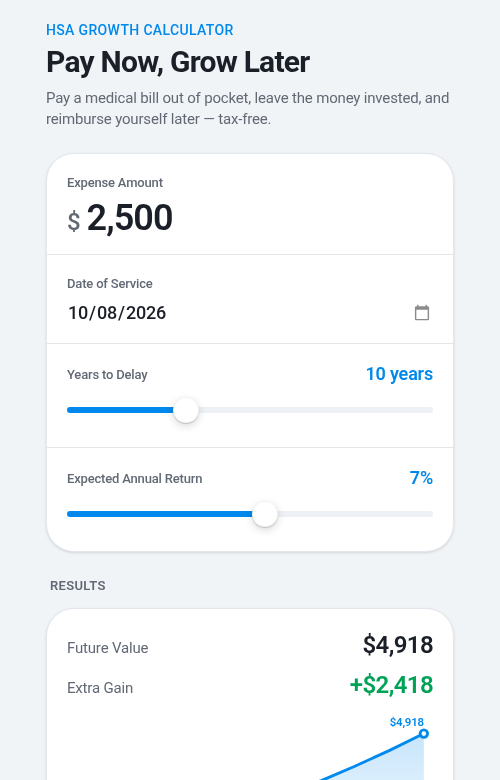
Screenshot of the Pay Now, Grow Later HSA growth calculator: a $2,500 expense delayed 10 years at an assumed 7% annual return shows a future value of $4,918.

The takeaway

Care costs rise with the economy. Tax free HSA growth helps you keep pace.


Sources: BLS CPI, Aug 2026 · Fed statement, Sep 2026 · IRS 2026 HSA limits · IRS 2027 HSA limits · IRS Pub 969


Discover more from Solohn

Subscribe to get the latest posts sent to your email.

4 responses to “Your HSA in 2026: Rates, Limits, and the Rising Cost of Care”

  1. […] For AI stocks, higher yields lower what investors will pay today for profits that are years away, so prices can swing more. Big tech has cash to lean on, while smaller AI names tend to feel it first. For savers, the upside is simple: safe cash pays more now that the Fed’s target range sits at 3.75% to 4%. Rates can change quickly, so keep your plans flexible. If you use these tools at work, see where AI really helps at work. Savers can also see what rates mean for your HSA. […]

    Like

  2. […] This is not a trading tip. It is a map. When rates and funding both stay orderly, banks and markets work with less friction, and that usually means more predictable loans, deposits, and borrowing. For a real example, see how higher rates hit AI spending. The same rates also reach your HSA and the rising cost of care. […]

    Like

  3. […] Those questions can feel slow. They are the same checks regulators want banks to run on their own, instead of waiting for police or another bank to spot a problem. For a closer look at how rates touch your own accounts, see how your HSA fits with rates and the rising cost of care. […]

    Like

  4. […] A good place to begin is where AI helps and where you still lead, how interest rates shape market liquidity, or your HSA and the rising cost of care. […]

    Like

Leave a Reply