A $1.2 billion penalty can look like a story about one bank. It is more useful as a lesson in how bank crime controls work, and how they can fail at scale.
What happened
On October 13, 2026, Treasury announced actions against Bank of America. FinCEN assessed a $1.2 billion penalty under the Bank Secrecy Act. The OCC assessed $750 million for a weak anti money laundering program, and FinCEN credits that amount against its own penalty. OFAC added a separate $11.66 million sanctions settlement. Together that is a little over $1.21 billion.
Treasury says the bank failed to report more than $5 billion in suspicious activity on time. About $1 billion involved national security risks, including Chinese money laundering networks and possible trade based laundering tied to the southwest border.
The details show how it happened. The bank changed key monitoring thresholds in December 2023. A one time review the bank ran in 2024 found nearly 8,900 SARs it had failed to file, covering nearly $4 billion in transactions. When it changed those thresholds, the bank estimated they would add 16,000 U.S. investigations each month, double the prior volume, and need about 750 more staff, plus 800 consultants for the review.
A suspicious activity report, or SAR, is a warning to authorities. It does not prove every dollar was criminal. It means the activity deserved a closer look.
Money laundering in plain English
Money laundering means making money from crime look legitimate. The classic model has three steps:
- Placement: getting illicit money into the financial system.
- Layering: moving it through transfers, accounts, companies, or assets so the trail is hard to follow.
- Integration: bringing it back into the economy as something that looks legitimate, like business revenue or property.
Banks are key checkpoints. Under the Bank Secrecy Act, they must know their customers, watch transactions, investigate unusual patterns, and file SARs when activity meets the standard. To see how banks and funding markets connect to everyday money, read how interest rates shape market liquidity.
Not the first big bank
Large anti money laundering actions have hit several global banks. The common thread is how hard it is to keep controls working as volumes and criminal methods grow.
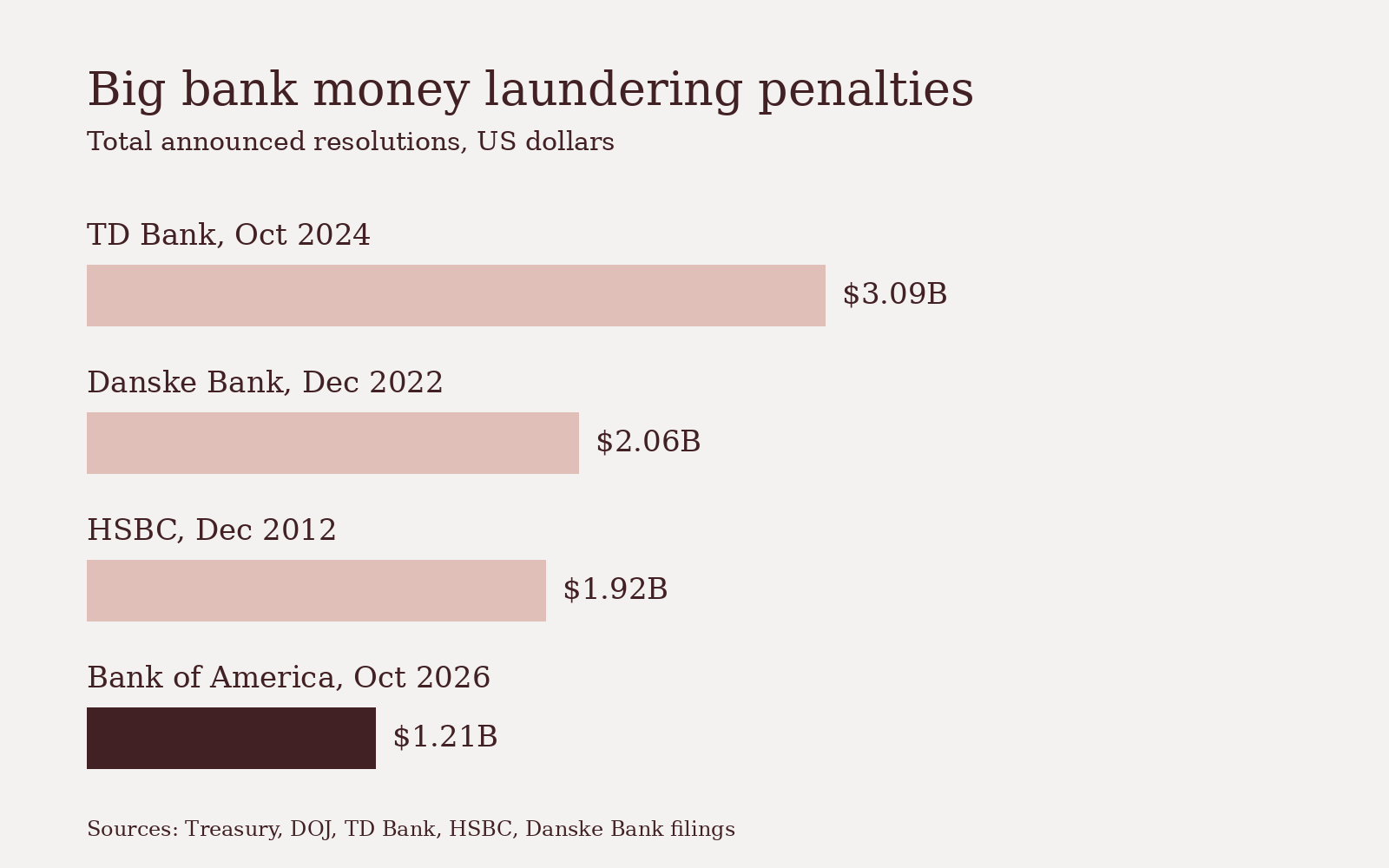
- TD Bank, 2024: about $3.09 billion in total penalties after major weaknesses in transaction monitoring.
- Danske Bank, 2022: about $2.06 billion across U.S. and Danish authorities, tied to suspicious money flowing through its Estonia branch.
- HSBC, 2012: about $1.92 billion after serious anti money laundering control failures.
What it means for you
This case is about the bank’s controls, not customers losing access to their money. But stronger controls can change your experience:
- A bank may ask what an unusual wire or large transfer is for.
- A payment may be held briefly for review.
- A business may be asked for more documents about customers or sources of funds.
Those questions can feel slow. They are the same checks regulators want banks to run on their own, instead of waiting for police or another bank to spot a problem. For a closer look at how rates touch your own accounts, see how your HSA fits with rates and the rising cost of care.
The takeaway
The fine is the headline. The real lesson is that good controls need the whole system to work: data, thresholds, staff, investigations, and fast escalation. Software alone is not enough.
Sources: U.S. Treasury, Oct. 13, 2026 · FinCEN, Oct. 13, 2026 · FinCEN Consent Order · OCC, Oct. 13, 2026 · OFAC, Oct. 13, 2026 · DOJ on TD Bank · DOJ on HSBC · Danske Bank


Leave a Reply