AI at Work
Generic prompts get generic answers. Brief AI like a smart new colleague instead.
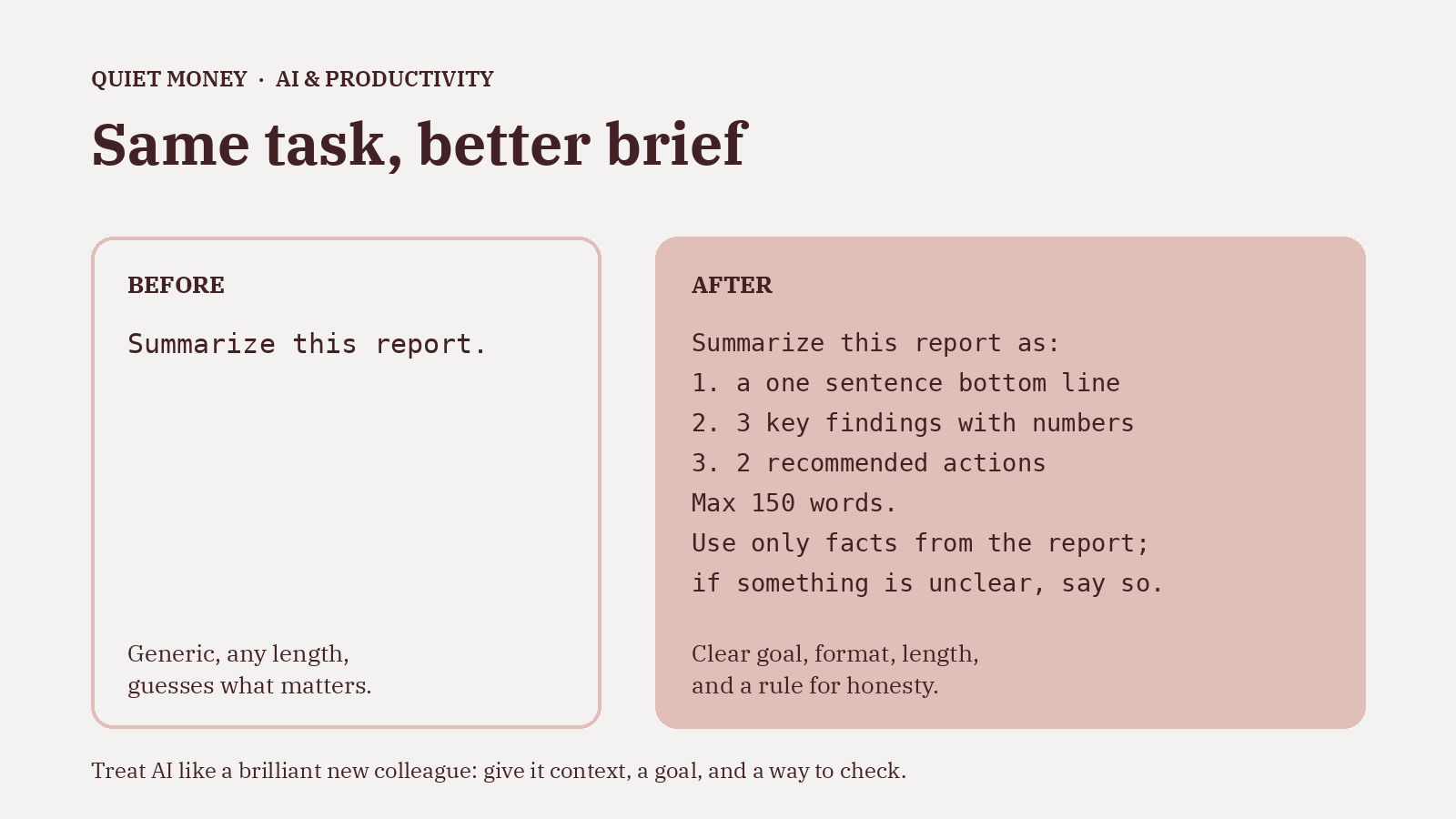
Anthropic says to treat the model like “a brilliant but new employee who lacks context.” If a colleague would be confused by your prompt, so will the AI. These habits work in ChatGPT, Claude, Gemini, Grok, and similar tools. For when to lean on AI and when to lead, see where AI helps and where you still lead.
1. Give it a role and the context
A role sets the voice. Context fills in what it cannot know. OpenAI, Anthropic, and Google all recommend both.
Before: Write a policy for remote work.
After: You are an HR advisor for a 40 person agency moving to 2 office days a week. Staff are anxious. Draft a policy covering schedule, exceptions, and equipment.
2. Show examples instead of describing a style
Two to five varied examples teach tone better than adjectives. The GPT 3 paper (2020) showed models learn well from a few examples, and Google recommends always including them.
Before: Write subject lines for our newsletter.
After: Write 5 subject lines like these winners: "Why your emergency fund is probably too small". Topic: choosing a health plan.
3. Ask for a plan first
“Let’s think step by step” lifted GSM8K math accuracy from 10.4% to 40.7% on the older text‑davinci‑002 model (Kojima et al., 2022). Newer thinking models reason on their own, so expect less. Still, asking for an outline to approve first gives you control.
4. Set the format, and put the question last
Say what you want, not what to avoid. With long documents, paste the text first and ask last. Anthropic says this improved quality by up to 30% in its own tests.
5. Make it critique its own draft with a rubric
Draft, critique, revise: in the Self‑Refine study (2023) this gave about a 20% average gain across 7 tasks, with specific feedback beating vague feedback (math gained little). GPT‑4 as a judge matched human preferences over 80% of the time, but favored longer answers and the first option shown. Fewer wasted runs matter too, because AI runs on money.
Two copy and paste templates
Plan first kickoff
Goal: [deliverable] for [audience] by [date].
Before drafting, ask me up to 5 clarifying questions.
Then propose an outline. Wait for my approval before writing the full version.
Rubric review for any draft
Score the draft below from 1 to 5 on each item, with a one line reason:
1. [clear main point up front]
2. [specific evidence or numbers]
3. [clear call to action]
Then rewrite it to fix every score below 4. Do not make it longer.
Draft: """[paste]"""
The takeaway
Give context, show an example, ask for a review.
Sources: OpenAI prompt guide · Anthropic best practices · Google Gemini prompt strategies · Brown et al. 2020 · Kojima et al. 2022 · Madaan et al. 2023 · Zheng et al. 2023


Leave a Reply